What Is Career? Meaning, Examples, and Pathways
When people ask "what is career," they often expect a list of jobs. The better answer is broader: a career is the long-term pattern of work, learning, decisions, roles, and growth that shapes how you contribute over time. It can include paid jobs, education, unpaid experience, skill building, career changes, and the values that guide your choices. If you are a student, changing direction, or simply trying to understand your next step, a career exploration starting point can help you turn a vague question into clearer reflection.

What Is a Career?
A career is the ongoing story of your work life. It is not only the job title you have today. It includes the roles you take, the skills you build, the industries you explore, the people you serve, the problems you solve, and the choices you make as your interests and circumstances change.
A simple career example might be: high school student, part-time retail assistant, business major, marketing intern, social media coordinator, brand strategist, and later small business owner. Each step may look different, but together they form a career because they show a developing direction.
Another example could be someone who begins as a nursing assistant, studies public health, works in community education, and later moves into healthcare program management. The common thread is not one job title. It is the relationship between skills, interests, responsibility, learning, and contribution.
That is why a career is best understood as a pathway, not a single stop. A job may be one position. A career is the larger pattern those positions create.
Career vs Job vs Profession
The words career, job, and profession are related, but they do not mean exactly the same thing.
A job is a specific role you do for pay or experience. It may be short term or long term. A summer cashier role, a freelance design project, or an entry-level analyst position can all be jobs.
A career is the larger direction those jobs support. It may include many jobs, pauses, training periods, volunteer roles, and transitions. You can change jobs without changing careers. You can also change careers by moving into a field that uses different interests, skills, or goals.
A profession usually refers to a field with a recognized body of knowledge, standards, training expectations, or credentials. Examples include teaching, law, medicine, engineering, accounting, counseling, and architecture. Some careers are professions, but not all careers require a formal professional license.
The distinction matters because it reduces pressure. You do not need to know your lifelong career from one job. Instead, each job can become evidence. It can show you what energizes you, what drains you, what skills you want to deepen, and what work environments fit you better.
What Is Career in Life?
Career in life means more than employment. It is the way your work choices connect with your identity, values, relationships, learning, financial needs, and sense of contribution. For some people, career success means leadership and income. For others, it means creativity, stability, service, flexibility, or time for family and community.
This life-centered view is especially useful for students and career changers. Instead of asking only "Which job pays well?" you can ask better questions:
- What activities make me curious enough to keep learning?
- What problems do I naturally notice and want to solve?
- What kinds of people do I enjoy helping or collaborating with?
- What lifestyle needs should my career support?
- What skills am I willing to practice for years?
These questions do not produce a perfect answer in one sitting. They help you build a more honest picture of direction. A structured career reflection can support that process by giving you language for your interests, preferences, and possible next steps without treating the result as a fixed label.

What Is a Career Pathway?
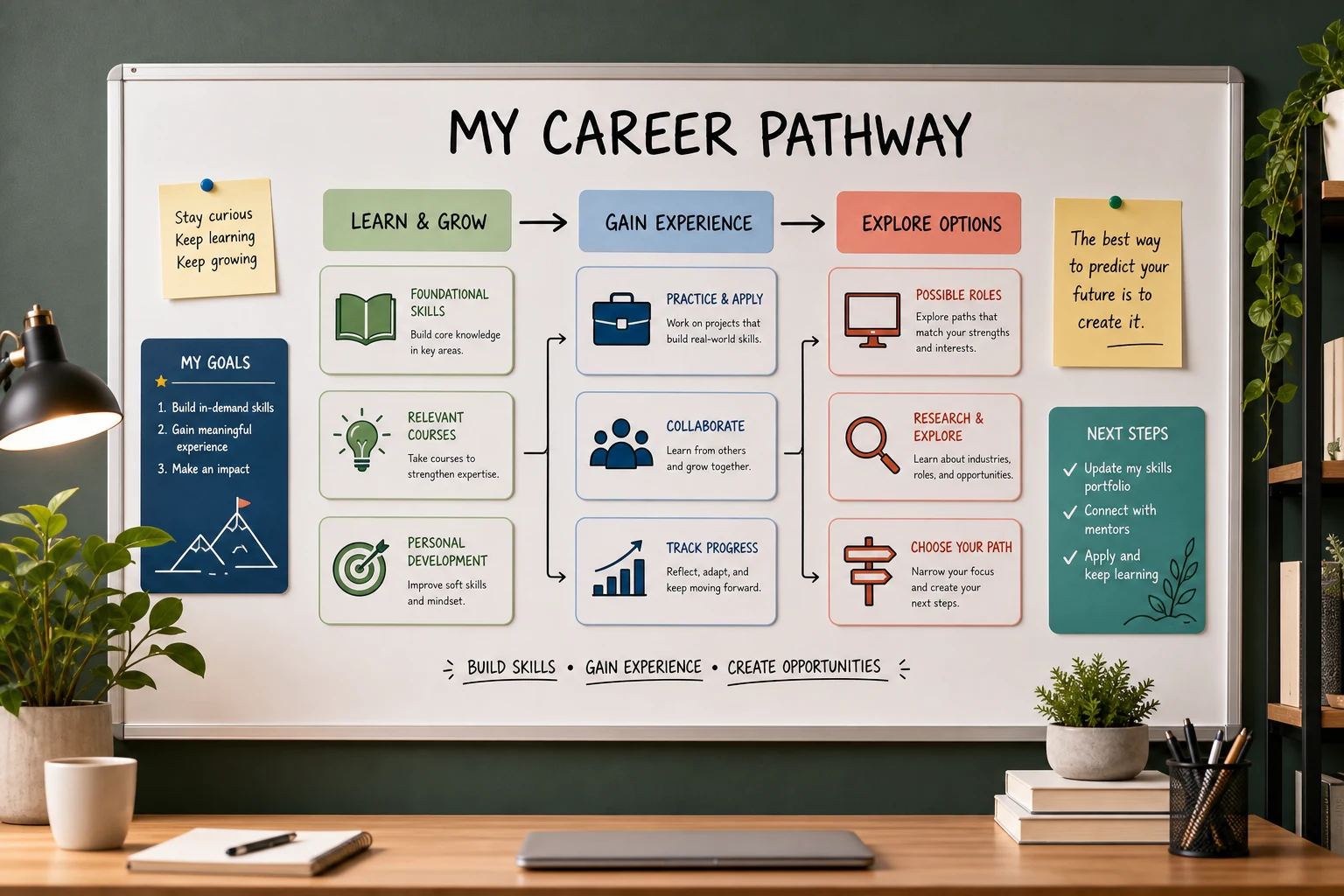
A career pathway is the sequence of steps that helps you move through learning, experience, and responsibility. It can include school subjects, certificates, internships, entry-level jobs, lateral moves, promotions, portfolio projects, mentoring, and career changes.
Career pathways are not always straight. Some people follow a vertical path, moving from assistant to specialist to manager to director. Others follow a lateral path, moving across related roles to build range. Someone in customer support might move into account management, user research, training, or operations. Someone in physical education might move into coaching, athletic training, sports administration, wellness education, or recreation management.
Pathways can also be exploratory. A student interested in science and communication may try tutoring, lab work, science writing, and public health volunteering before seeing which direction feels strongest. A working adult may test a new field through a short course, informational interviews, or a side project before making a larger transition.
The point is not to predict every step. The point is to create a map that can be updated. Good pathways leave room for new information.
Types of Career and Career Examples
There are many ways to describe types of career. For planning purposes, these categories are practical:
- Skill-based careers, such as software development, design, carpentry, data analysis, writing, or culinary work.
- Service-based careers, such as teaching, healthcare support, social work, hospitality, coaching, or customer success.
- Knowledge-based careers, such as research, law, finance, engineering, medicine, or policy.
- Creative careers, such as film, music, animation, marketing, photography, product design, or content strategy.
- Entrepreneurial careers, such as freelancing, consulting, building a small business, or launching a product.
- Portfolio careers, where a person combines several income streams or roles, such as teaching, consulting, writing, and project work.
You may also hear people talk about "the 4 career types." The exact four depend on the framework being used. A simple version is people-focused, data-focused, idea-focused, and hands-on careers. Another version might group careers by sectors, such as business, health, technology, and public service. Treat these groupings as thinking tools, not strict boxes.
Career examples can be very direct: teacher, electrician, graphic designer, accountant, software engineer, chef, nurse, project manager, mechanic, journalist, physical therapist, or entrepreneur. They can also be blended: a teacher who becomes an education technology designer, or a nurse who moves into health informatics.
How Career Choice Works
Career choice is the process of matching what you know about yourself with what you know about the world of work. It combines interests, skills, values, personality, practical constraints, education options, job market information, and real experience.
Many people make career choice harder by looking for one perfect title. A more useful approach is to build a shortlist. Start with broad fields, then compare specific roles inside each field. For example, "healthcare" could mean direct patient support, lab science, administration, technology, education, or public policy. "Technology" could mean coding, product management, cybersecurity, design, data, support, or sales engineering.
Try this simple action component:
- List five activities you enjoy or tolerate well.
- List five skills people ask you for help with.
- List three work environments you prefer.
- Choose three career examples that combine at least two of those lists.
- Research one real job posting for each example and note the required skills.
This turns career choice into evidence gathering. You are not trying to solve your whole life at once. You are looking for the next useful experiment.
Career Development: How a Career Grows
Career development is the ongoing process of learning, choosing, testing, adapting, and improving your work direction. It can happen through formal education, workplace feedback, mentoring, self-study, volunteering, projects, networking, and reflection.
Healthy career development usually includes four habits.
First, self-awareness. Notice your interests, strengths, values, and preferred work style. Second, opportunity awareness. Learn what roles exist, what skills they require, and what a normal entry point looks like. Third, decision-making. Compare options using both motivation and practical reality. Fourth, action. Build skills, talk to people, try projects, apply for roles, or adjust your plan.
Career development is not only for people who feel lost. It is also for people who are doing well but want to grow intentionally. A teacher may develop toward curriculum leadership. A designer may grow into product strategy. A retail worker may discover strengths in operations and move toward logistics.
Because careers unfold over time, your plan should be flexible. New technologies, industries, personal priorities, and life stages can change what "right fit" means. The goal is not to lock yourself into one answer. The goal is to keep making informed choices.
A Simple Way to Think About Your Career
If you are still asking what is career for your own life, use this three-part frame: direction, evidence, and next step.
Direction is your current best guess about where you want to explore. Evidence is what you learn from classes, jobs, projects, conversations, and reflection. Next step is the smallest practical action that gives you more evidence.
For example, if you think you might like design, your next step may be taking a short course, redesigning a simple flyer, interviewing a designer, or comparing job descriptions. If you think you might like physical education, your next step may be assisting a coach, learning about exercise science, observing a recreation program, or researching related roles.
CareerQuiz.me fits this stage best as an educational self-discovery tool. It can help you review interests and preferences, then use the result as one input for discussion, research, and planning. If you want a gentle place to begin, you can explore career interests and then compare the result with real-world information from courses, mentors, job descriptions, and experience.

FAQ
What is a career example?
A career example is a long-term pattern of related work and learning. For instance, a person may begin as a classroom assistant, study education, become a teacher, and later move into curriculum design. Those roles together form a career pathway.
What is career in life?
Career in life means how your work, learning, values, goals, and contribution fit into your broader life. It includes employment, but it also includes personal priorities, growth, relationships, and the kind of impact you want your work to have.
What is career job?
A career job is usually a job that connects to your longer-term direction. It may help you build relevant skills, experience, relationships, or credentials. A short-term job can also become part of a career if it teaches you something useful.
What is career in physical education?
Career in physical education can include teaching PE, coaching, athletic training support, wellness education, recreation management, sports administration, fitness instruction, or exercise science pathways. The right direction depends on your interests, training, and preferred work setting.
What is career and types of career?
A career is your long-term work and development path. Types of career can be grouped by skills, industries, work styles, or goals, such as service careers, creative careers, technical careers, knowledge-based careers, entrepreneurial careers, and portfolio careers.
What is the deep meaning of career?
The deep meaning of career is the way your work expresses learning, contribution, identity, and choice over time. It is not only what you do for money. It is also how you grow and how your abilities serve real needs.
Is a career the same as a profession?
No. A profession is usually a field with recognized training, standards, or credentials. A career is broader. It may include one profession, several jobs, education, unpaid experience, transitions, and personal development across your working life.