Jobs That Help: How to Find Meaningful Work That Fits You
Searching for jobs that help usually means more than wanting a paycheck. You may want work that serves people, supports a community, protects animals, improves mental well-being, or makes everyday life safer and fairer. The challenge is that "helping" can look very different from one job to another. Some roles are hands-on and emotional. Some are quiet and analytical. Some require a license, while others can begin with short training or related experience. If you are still sorting out your strengths, values, and work preferences, a structured look at your career interests and work preferences can give you a clearer starting point.
What Jobs That Help Really Have in Common
Jobs that help are roles where your work improves another person's situation, a group's access to resources, or a community's long-term well-being. That does not mean every helping job feels warm or inspiring every hour of the day. Many involve paperwork, conflict, tight budgets, rotating schedules, or emotionally heavy situations.
The better question is not "Which job helps the most?" It is "What kind of help can I offer consistently without burning out?" A helping career can be direct, like teaching a child, assisting a patient, supporting a client, or responding in an emergency. It can also be indirect, like managing a nonprofit program, improving environmental systems, coordinating benefits, designing accessible technology, or analyzing data for a public service team.
Think of helping work through four lenses:
- Who you want to serve: children, older adults, veterans, immigrants, people with disabilities, animals, students, patients, job seekers, or local communities.
- How you want to help: teaching, advising, organizing, protecting, healing, designing, researching, advocating, or coordinating.
- How close you want to be to crisis: prevention, everyday support, case management, emergency response, or long-term recovery.
- What training path fits your life: no degree, certificate, associate degree, bachelor's degree, graduate degree, apprenticeship, or license.
When those four pieces fit together, a helping job is more likely to feel meaningful and sustainable.
Common Types of Jobs That Help People
Many search results focus on lists of job titles, but categories are more useful when you are still exploring. Start with the kind of contribution you want to make, then compare titles inside that category.
Healthcare support roles help people navigate care, scheduling, records, insurance, rehabilitation, or daily health needs. Some are clinical, such as nursing assistant or EMT. Others are administrative, such as patient care coordinator, medical receptionist, benefits coordinator, or community health worker.
Education and youth roles help children, teens, and adult learners build skills. This group can include teacher assistant, tutor, career mentor, school support staff, youth program coordinator, academic advisor, childcare worker, and training specialist.
Human services and community roles help people access housing, food, benefits, employment support, crisis resources, or social programs. Examples include case aide, outreach worker, employment specialist, peer support worker, program assistant, shelter coordinator, and nonprofit operations associate.
Public service and safety roles help communities function. These can include emergency dispatch, public health support, code enforcement, transportation support, library services, local government administration, and disaster recovery coordination.
Environmental and animal-focused roles help through conservation, sustainability, rescue, care, compliance, or education. If you want jobs that help animals or the environment, compare daily realities carefully. Some positions are hands-on; others focus on data, policy, facilities, fundraising, or public education.
Creative jobs that help others also exist. Designers, writers, video producers, UX researchers, community storytellers, and communications specialists can make services easier to understand, increase awareness, and help mission-driven organizations reach the right people.
Jobs That Help People and Pay Well
People often search for jobs that help and pay well because purpose alone does not cover rent, loans, family needs, or long-term security. That is a reasonable concern. The key is to separate "helping" from "underpaid." Some helping fields are modestly paid at entry level, but pay can rise with specialization, licensure, management responsibility, union coverage, government employment, technical skills, or high-demand locations.
Higher-paying helping paths often fall into a few groups:
- Licensed clinical or therapeutic work, such as nursing, occupational therapy, speech-language pathology, counseling, or social work leadership.
- Program and operations leadership in nonprofit, healthcare, education, public health, or government settings.
- Technical support for public-good systems, such as data analysis, cybersecurity, accessibility design, grants operations, or product management for mission-driven teams.
- Skilled trades and infrastructure roles that support safety, housing, transportation, energy, or emergency services.
- Specialized sales, consulting, or account management roles for ethical products that serve schools, clinics, nonprofits, or community organizations.
Before you choose a path because it sounds high-paying, check three things: the realistic entry-level range, the time and cost of training, and the working conditions. A role can pay well because it requires advanced credentials, involves risk, carries heavy responsibility, or has difficult hours. Meaningful work should still fit your health, family responsibilities, and long-term energy.
Jobs That Help People Without a Degree
You do not always need a four-year degree to begin helping others. Many jobs that help people without a degree rely on reliability, communication, compassion, organization, basic technology skills, and willingness to complete role-specific training.
Possible starting points include:
- Home health aide or personal care aide
- Medical receptionist or patient service representative
- Community outreach assistant
- Shelter support staff
- Nonprofit administrative assistant
- Childcare assistant
- Teacher aide, depending on local rules
- Emergency dispatcher
- Animal shelter assistant
- Peer support or recovery support roles, where lived experience and certification rules vary
- Job coach assistant or workforce program assistant
- CDL training routes for transportation roles that serve schools, healthcare access, public transit, or logistics
The "without a degree" path still needs research. Some roles require background checks, certifications, physical stamina, evening shifts, supervised hours, or state-specific requirements. If a posting says "degree preferred," do not assume you are automatically out. Look at the required skills, related volunteer work, customer service experience, caregiving experience, bilingual ability, software familiarity, and whether the employer offers paid training.
For people who are exploring fit before committing to school, a structured career preference quiz can help you compare whether you are drawn more toward people-facing support, practical hands-on service, administrative coordination, creative communication, or analytical problem solving.
Helping Careers for Introverts and Sensitive Workers
Some people want to help but worry that every helping job requires constant conversation, public speaking, or high emotional intensity. It does not. Jobs that help people for introverts often work best when they include clear tasks, predictable blocks of focus time, smaller groups, or behind-the-scenes contribution.
Consider roles such as grant writer, research assistant, medical records specialist, data analyst for a public service organization, instructional designer, benefits processor, accessibility tester, animal care support, lab technician, library assistant, environmental technician, or nonprofit finance assistant. These roles can still serve people, but the helping happens through accuracy, systems, documentation, design, or care routines rather than constant direct interaction.
If you are interested in jobs that help people's mental health, be especially careful with role boundaries. Licensed mental health counseling, therapy, psychology, and clinical social work require formal education, supervised experience, and state rules. But there are adjacent ways to support well-being, such as crisis line operations support, peer support under appropriate supervision, wellness program coordination, patient navigation, school support roles, community education, HR well-being coordination, and user experience work for mental health resources.
The right question is not whether you are extroverted enough. It is whether the job's daily interaction style matches your nervous system, communication strengths, and recovery needs.
How to Search for Jobs That Help Near You
Local intent matters. Searches like jobs that help Milwaukee, jobs that help people near me, state of Wisconsin jobs, city jobs, county jobs, university jobs, and nonprofit job boards are usually not asking for a broad inspirational list. They are asking, "Where do I actually look?"
Use a layered search system:
- Search by mission terms: nonprofit, public health, community outreach, human services, animal welfare, youth services, environmental services, veteran support, disability services, immigrant services, homelessness services.
- Search by employer type: city, county, state, school district, university, hospital, clinic, library, shelter, foundation, workforce center, public agency, social enterprise.
- Search by role function: coordinator, assistant, advocate, specialist, case aide, program associate, navigator, dispatcher, technician, trainer, benefits, outreach, operations.
- Search by training support: tuition assistance, paid training, apprenticeship, relocation assistance, CDL training, internship, AmeriCorps, entry-level.
- Search by accessibility needs: remote, hybrid, part-time, evening, no degree, bilingual, quiet work, field work, people-facing, administrative.
If you are searching a specific place, add the city or state only after you know the job family. "Community outreach coordinator Milwaukee" is usually more precise than "jobs that help Milwaukee." "Veterans services assistant state jobs" may work better than a broad job board search. Local workforce centers, 211-style resource directories, and public agency pages can also point you toward training programs, resume support, interview preparation, and placement services.
A Simple Fit Checklist for Helping Careers
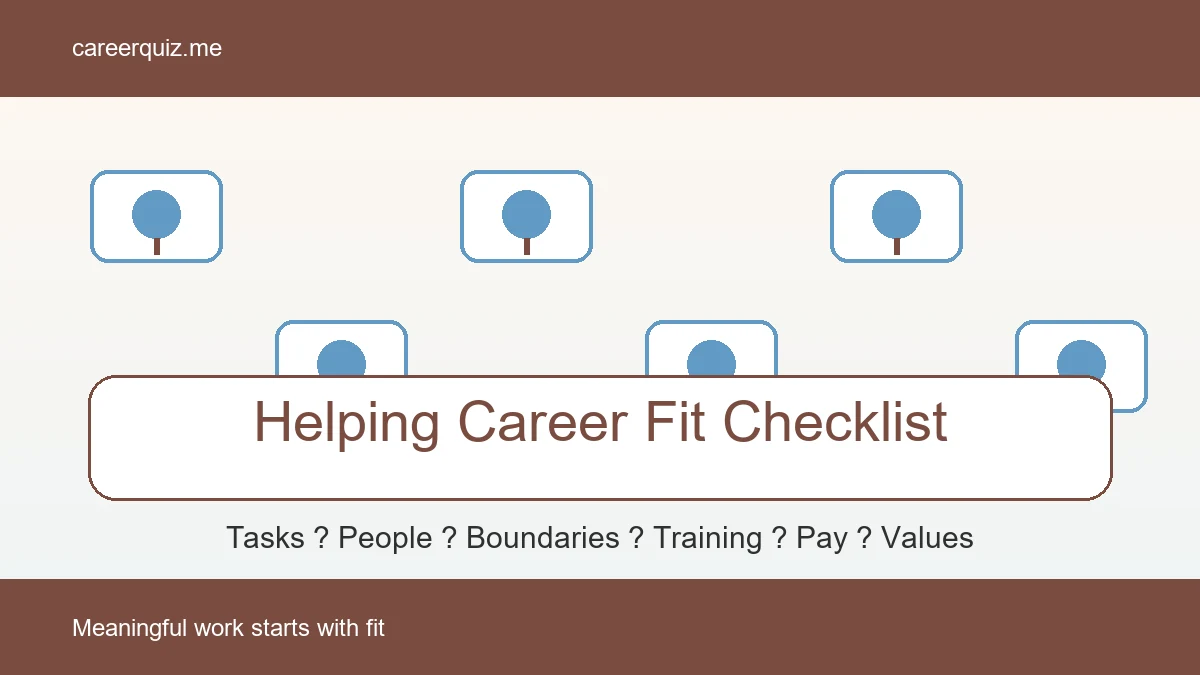
Before applying broadly, use this checklist to compare a role against your real life.
- Daily task fit: Would you rather talk, teach, organize, write, analyze, care, repair, respond, design, or coordinate?
- Population fit: Which group do you feel prepared to serve with patience and respect?
- Boundary fit: Can you leave work at work, or does the role require emotional support you are not ready to provide?
- Training fit: Can you handle the time, cost, prerequisites, licensing rules, or physical demands?
- Pay fit: Does the realistic starting pay support your needs, and is there a path to growth?
- Schedule fit: Are nights, weekends, travel, emergencies, or shift work acceptable?
- Environment fit: Do you prefer offices, schools, clinics, homes, outdoors, vehicles, remote work, or field visits?
- Values fit: Does the organization serve people in a way you can stand behind?
Then choose three job titles, not thirty. Read real postings. Highlight repeated skills. Notice what excites you and what drains you. Your reaction to the details often teaches you more than the title itself.
Turn a Helping-Career Idea Into a Next Step
Jobs that help are not one career lane. They are a family of paths across healthcare, education, social services, public agencies, environmental work, animal care, nonprofit operations, technology, and creative communication. The best fit is usually where your values, strengths, training capacity, and daily work style overlap.
If you feel pulled toward helping work but unsure which direction fits, start with one small experiment. Interview someone in a role you admire. Volunteer for a limited shift. Compare three job descriptions. Take a short course. Shadow a team if possible. Write down the parts of service that energize you and the parts that feel too heavy.
You can also use CareerQuiz.me as a career exploration starting point to reflect on your interests before choosing a training path, job board, or local program. Treat the result as one input in your decision, then combine it with real job research, trusted advice, and practical constraints.
FAQ
What job is best for helping people?
There is no single best job for helping people. A teacher, nurse, social worker, EMT, community health worker, public librarian, nonprofit coordinator, patient navigator, and environmental technician can all help in different ways. The best fit depends on who you want to serve, how much direct contact you want, what training you can complete, and what daily tasks suit your strengths.
What jobs help people and pay well?
Helping roles with stronger pay potential often involve licensure, technical skills, leadership, or specialized responsibility. Examples may include nursing, therapy-related fields, healthcare administration, public health management, nonprofit program leadership, data roles for public service teams, and skilled trades tied to safety or infrastructure. Always check current local pay ranges and entry requirements before committing to a path.
What jobs help people in need without a degree?
Entry points can include home health aide, medical receptionist, community outreach assistant, shelter staff, nonprofit administrative assistant, childcare assistant, emergency dispatcher, job coach assistant, animal shelter assistant, and workforce program assistant. Requirements vary by employer and state, so read postings for certifications, background checks, training, and experience expectations.
Are there jobs that help people for introverts?
Yes. Introverts may prefer helping roles with smaller groups, clearer routines, or behind-the-scenes impact. Grant writing, data analysis, medical records, benefits processing, instructional design, accessibility testing, animal care, library support, environmental fieldwork, and nonprofit operations can all support people without requiring constant high-volume interaction.
What jobs help people's mental health?
Licensed roles include counselors, therapists, psychologists, psychiatric nurses, and clinical social workers, each with formal education and supervised practice requirements. Adjacent support roles may include peer support, patient navigation, school support, community education, wellness coordination, and operations work for mental health services. For personal mental health concerns, seek qualified professional support.
How do I find jobs that help people near me?
Search by mission, employer type, and function. Try combinations such as "community outreach assistant," "public health coordinator," "veterans services specialist," "animal shelter assistant," "workforce program assistant," or "youth program coordinator" plus your city or state. Also check city, county, state, school, hospital, university, nonprofit, and local workforce pages.
Can I make $10,000 a month or $2,000 a day without a degree in a helping job?
Those numbers are possible only in limited situations, usually involving business ownership, high-ticket sales, specialized contracting, senior leadership, rare overtime-heavy work, or very high-demand skills. They are not a practical baseline for most helping careers. A stronger plan is to compare entry pay, growth paths, training cost, and whether the work remains sustainable.