How to Know What Job Is Right for You: A Practical Career Fit Guide
If you are wondering how to know what job is right for you, you are probably not looking for a magical answer. You are looking for a way to make the question less foggy. A good job fit usually sits at the intersection of what interests you, what you can become good at, what supports your life, and what kind of work environment helps you do your best thinking. A structured career quiz can help you name patterns, but the strongest career decisions come from combining self-reflection with real-world testing.
This guide gives you a practical framework for figuring out what career is right for you, whether you are choosing a first path, considering a new job, changing careers, or trying to understand why your current role feels off.

Start With Fit, Not a Perfect Answer
The phrase "right job" can sound final, as if one role must define your whole future. In reality, job fit is usually a moving target. Your interests change as you gain experience. Your financial needs may shift. The work environment that helped you at 22 may not be the one that supports you at 35.
So instead of asking, "What is the one correct job for me?" ask, "Which roles are most likely to fit my current strengths, interests, values, and constraints?" That shift matters. It turns career choice from a single high-pressure decision into a series of informed experiments.
Four signals are especially useful:
- Interest: the topics, problems, and tasks that hold your attention even when they are difficult.
- Ability: the skills you already use well, plus the skills you are willing to build.
- Values: what you need work to give you, such as autonomy, stability, income, creativity, service, status, flexibility, or growth.
- Environment: the pace, team style, structure, location, and feedback rhythm that help you perform consistently.
When all four signals point in a similar direction, the role deserves serious exploration. When they conflict, you have useful information rather than failure. For example, you may love design but dislike client-facing work, enjoy data but not solitary analysis, or value high income but need predictable hours. Those tensions help you refine the search.
How to Figure Out What Career Is Right for You
To figure out what career is right for you, start by separating identity from evidence. "I am a people person" or "I am analytical" may be true, but those labels are broad. You need examples from your own life.
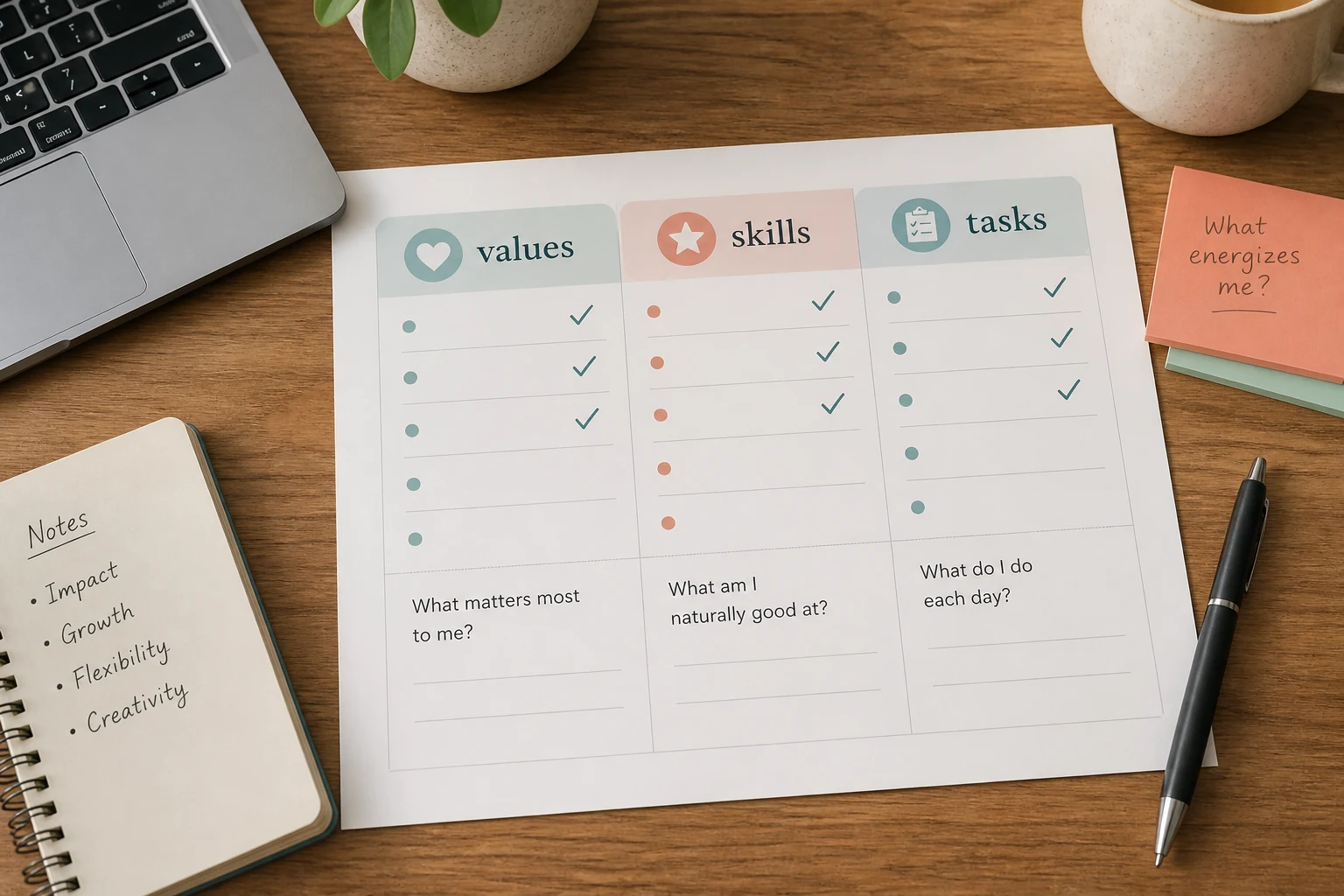
Use three quick inventories:
| Question | What to Look For |
|---|---|
| What tasks make time pass quickly? | Natural interest and attention |
| What do people already ask me to help with? | Visible strengths and trusted skills |
| What trade-offs am I unwilling to make? | Values, limits, and lifestyle needs |
Next, turn each answer into job clues. If people ask you to simplify confusing topics, roles in training, customer education, writing, operations, or user support may be worth researching. If you enjoy building systems, look at project coordination, analytics, engineering, supply chain, or business operations. If you care about direct impact, explore education, health support, counseling-adjacent roles, social services, or nonprofit work, while checking the training each role requires.
This is also where job descriptions become useful. Do not read them only as application requirements. Read them as a preview of daily life. Highlight the verbs: analyze, present, coordinate, sell, troubleshoot, teach, design, document, negotiate, care, inspect, manage. A job that looks impressive from the outside may feel wrong if its daily verbs drain you.
Use Tests and Quizzes Without Letting Them Decide for You
A career test, job quiz, career aptitude test, or career assessment can be a helpful starting point because it forces you to answer questions in a structured way. That structure is useful when your thoughts are scattered. A good quiz can surface patterns in your interests, work preferences, and possible career families.
The key is to treat results as clues, not instructions. If a result suggests "Social" or "Investigative" work, ask what part of that result feels true. Is it the people contact, the problem solving, the research, the independence, or the learning curve? If a recommended career surprises you, do not reject it immediately. Study the underlying pattern behind the suggestion.
A free career preference assessment is most useful when you pair it with reflection questions like these:
- Which result descriptions felt accurate, and which felt too broad?
- What careers appeared more than once across different tools or exercises?
- Which suggested roles would I actually want to shadow, research, or try in a small way?
- What did the quiz miss about my constraints, location, health, family needs, finances, or education timeline?
This approach also helps with searches like "how to know what career is right for you quiz" or "how to know what job is right for you test." The quiz is not the whole decision. It is a mirror that helps you notice patterns, then decide what to verify next.
How to Know If a New Job Is Right for You
If you are evaluating a new job offer or a role you recently started, the question becomes more immediate: how to know if job is right for you when real responsibilities, people, and deadlines are involved?
Look beyond the title. A job title can hide major differences in manager style, workload, autonomy, training, schedule, and emotional demands. In the first weeks, track evidence in five areas:
- Energy: Do you feel challenged in a healthy way, or consistently depleted?
- Learning: Are you gaining skills that matter for your next step?
- Expectations: Do you understand what good performance looks like?
- People: Do communication norms help you work well?
- Trade-offs: Are the sacrifices acceptable for the pay, growth, stability, or mission?
The "3 month rule" for jobs is a common idea that says it often takes around three months to understand a new role's rhythm. Treat that as a reflection checkpoint, not a rigid rule. Some problems are normal early friction: learning systems, meeting new coworkers, adjusting to a new pace. Other problems deserve faster attention, such as unclear expectations, unsafe working conditions, repeated disrespect, or a role that is materially different from what was promised.
If you are unsure, write down what would need to improve for the job to become sustainable. Then separate what you can influence from what you cannot. You may be able to ask for clearer priorities, more feedback, training, or a different meeting rhythm. You may not be able to change the business model, the compensation band, or a manager's core behavior.
A Practical 30-Day Career Fit Experiment
You do not have to quit, enroll in a degree, or commit to a new industry to gather better evidence. A small experiment can tell you whether an idea deserves more time.
Use this 30-day plan:
- Choose two or three possible job directions.
- Read five job descriptions for each direction and list the repeated daily tasks.
- Talk to one person who does similar work, or listen to interviews and day-in-the-life resources.
- Try one tiny project that mirrors the work: analyze a dataset, draft a lesson, build a simple portfolio piece, write a support response, design a process, or plan a campaign.
- Score each direction from 1 to 5 on interest, skill growth, values fit, environment fit, and realistic next steps.

At the end of the month, do not ask which option is perfect. Ask which option produced the best evidence. Did you want to keep learning about it after the experiment ended? Did the daily tasks match your strengths? Did the role require trade-offs you can live with? Did your curiosity grow as you got closer to the work?
This kind of experiment is especially helpful for adults considering a career change. It reduces the risk of romanticizing a field from a distance. It also helps teenagers choosing a major, because a major is easier to choose when it connects to real tasks, not just school subjects.
What About Pay, Happiness, and No-Degree Paths?
Searches about the right job often include questions about income and happiness. Those questions are fair. Work has to support your life.
For example, "What job makes $10,000 a month without a degree?" depends heavily on skill, location, market demand, business model, risk, and experience. Sales, skilled trades, real estate, entrepreneurship, technology, and certain contract paths can reach high monthly income for some people, but they usually involve uneven earnings, training, licensing, portfolio building, or performance pressure. Instead of chasing a number alone, compare the path's requirements with your tolerance for risk and your willingness to build the needed skills.
The same is true of "the happiest profession." Happiness varies by person. Some people need autonomy. Some need teamwork. Some need visible impact. Others need intellectual challenge, physical movement, or reliable hours. A career that ranks highly in a survey may still be a poor fit if its daily work clashes with your values or energy.
Use pay and happiness data as context, then bring the question back to fit. The best job for you is not only the one that sounds good online. It is the one where your interests, abilities, values, environment, and realistic next steps line up well enough to keep testing.

Turn Your Best Clues Into a Next Step
By now, you should have a short list of better career clues: tasks you enjoy, skills you want to build, values you cannot ignore, environments that help you work well, and job directions worth testing. That is enough to move from wondering how to know what job is right for you into a practical next step.
Choose one action for this week. Explore a career exploration quiz, compare three job descriptions, schedule an informational conversation, or complete one small project related to a possible role. Keep the action small enough that you will actually do it, but specific enough to teach you something.

You do not need a lifetime answer before you begin. You need a clearer next experiment. Each experiment gives you more evidence, and evidence is what turns career confusion into direction.
FAQ
How do I figure out which job is best for me?
Start by listing your strongest interests, usable skills, non-negotiable values, and preferred work environment. Then compare those clues against real job descriptions and small experiments. The best job for you is usually the role that fits your daily energy, supports your life, and gives you a realistic path to grow.
How do I know what career is right for me?
Look for repeated patterns. If several exercises, conversations, job descriptions, and career test results point toward similar tasks or environments, you have a stronger signal. You still need to test the idea in the real world through projects, shadowing, coursework, volunteering, or entry-level experience.
Can a career quiz tell me what job I should have?
A career quiz can help you organize your interests and preferences, but it should not make the decision for you. Use it as one input alongside your skills, financial needs, values, education timeline, and real conversations with people in the field.
How do I know if a new job is right for me?
Track your first weeks carefully. Notice whether expectations are clear, whether the work builds useful skills, whether the culture supports healthy performance, and whether the trade-offs are acceptable. Some discomfort is normal during adjustment, but repeated misalignment deserves attention.
What if I have too many career interests?
Group your interests by task type. For example, writing, teaching, advising, and marketing may all involve communication. Data, research, finance, and operations may all involve analysis. Once you identify the shared task pattern, you can explore roles that combine several interests instead of choosing only one.
Should I choose a career based on money or passion?
Neither factor should stand alone. Money matters because work supports your life, and interest matters because you will spend many hours doing the work. A strong career choice usually balances pay, growth, skill fit, values, and sustainability.
What should I do if I still feel unsure?
Pick the next smallest experiment. Research one role, talk to one person, try one sample project, or compare three job descriptions. Career clarity often comes from action, not from thinking harder in isolation.