Holland Codes Career Quiz: Ultimate Guide to RIASEC Model & Personality Types
Introduction: Uncover Your Ideal Path: Understanding the Holland Codes
Feeling lost in a sea of career options? You're not alone. Many students, graduates, and professionals struggle with the big question: What career is right for my personality? The good news is that psychology offers a powerful, scientifically-backed tool to guide you. The Holland Codes, also known as the RIASEC model, provide a simple yet profound framework for understanding yourself and finding a career that truly fits. This guide will walk you through everything you need to know about the holland codes and how they can unlock your professional potential.
This framework forms the basis of many effective career assessments. It helps you connect your interests and personality to specific work environments where you are most likely to thrive. By understanding your unique code, you can move from confusion to clarity. Ready to begin your journey of self-discovery? A great first step is to take an AI-enhanced career quiz to see these principles in action.

What Are Holland Codes? John Holland's RIASEC Theory Explained
The Holland Codes are a theory of careers and vocational choice based on personality types. Developed by psychologist John L. Holland, this theory proposes that people and work environments can be classified into six main types. The central idea is that when your personality type aligns with your work environment, you experience higher job satisfaction, stability, and achievement. This powerful concept is the cornerstone of modern career assessment.
The Origins of the RIASEC Model: A Brief History
Dr. John Holland began developing his influential theory in the 1950s. He believed that career choices were an expression of personality. After extensive research, he identified six primary personality types and corresponding work environments, creating the acronym RIASEC. This model revolutionized career counseling by providing a structured, evidence-based method for guiding individuals toward fulfilling work. Its enduring relevance is a testament to its accuracy and practical value in career exploration.
How the RIASEC Model Works: Matching People to Environments
The core principle of the RIASEC model is person-environment fit. Holland's theory suggests that we are all drawn to work environments that match our personalities. For example, an analytical and curious person (Investigative type) would likely feel out of place in a highly structured, repetitive job (Conventional type) but would flourish in a research lab. The model helps identify your dominant personality types, usually represented by a three-letter code, to pinpoint the environments where your skills and interests can shine brightest.
Why Your Holland Code Matters for Career Planning
Understanding your Holland Code is like having a compass for your career journey. It provides a personalized language to describe what you enjoy and what you're good at, helping you filter through countless job titles to find ones that genuinely resonate with you. It’s a tool that empowers you to make informed decisions, whether you are choosing a college major, searching for your first job, or considering a career change. Discovering your code can be the most critical step you take toward building a career you love. Why not start your journey today?
Exploring the Six Holland Career Personality Types (RIASEC)
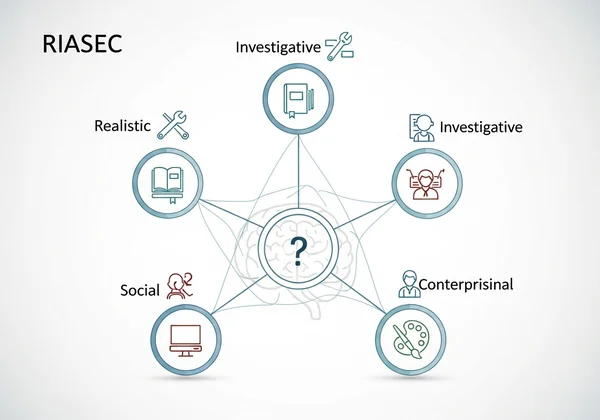
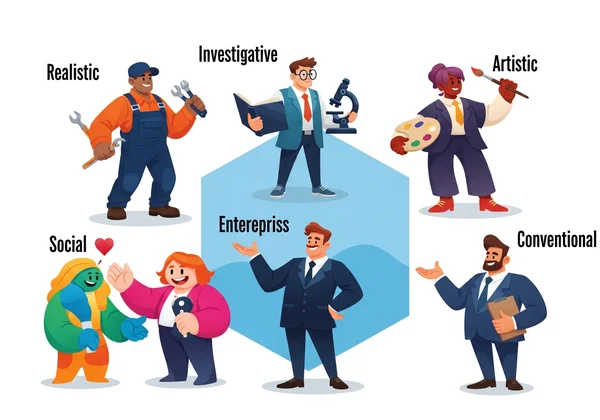
The RIASEC model is composed of six distinct types: Realistic, Investigative, Artistic, Social, Enterprising, and Conventional. While you might have traits from all six, you likely have two or three that are most dominant. Let's explore each of the career personality types in detail.
Realistic (The 'Doers'): Traits, Skills, and Ideal Careers
Realistic personality traits involve a hands-on, practical approach to life. 'Doers' enjoy working with tools, machinery, and physical objects. They are often practical, stable, and down-to-earth individuals who prefer concrete tasks over abstract ones.
- Skills: Mechanical aptitude, physical coordination, problem-solving with tangible objects.
- Ideal Work Environments: Outdoors, workshops, construction sites, or labs where they can use their hands.
- Example Careers: Electrician, pilot, chef, mechanical engineer, farmer, veterinarian.
Investigative (The 'Thinkers'): Traits, Skills, and Ideal Careers
Investigative personality traits are defined by curiosity, analysis, and a love for solving complex problems. 'Thinkers' are drawn to ideas, theories, and data. They are intellectual, introspective, and methodical in their approach.
- Skills: Research, mathematical abilities, scientific inquiry, critical thinking.
- Ideal Work Environments: Laboratories, universities, research institutions, and tech companies.
- Example Careers: Doctor, software developer, scientist, economist, market researcher.
Artistic (The 'Creators'): Traits, Skills, and Ideal Careers
Artistic personality traits center on creativity, self-expression, and originality. 'Creators' are imaginative, intuitive, and unconventional. They thrive in unstructured environments where they can use their creativity to produce unique work.
- Skills: Design, writing, performance, visual arts, musical talent.
- Ideal Work Environments: Theaters, design studios, museums, and freelance settings.
- Example Careers: Graphic designer, writer, musician, actor, architect, marketing manager.
Social (The 'Helpers'): Traits, Skills, and Ideal Careers
Social personality traits are characterized by empathy, cooperation, and a desire to help others. 'Helpers' are friendly, generous, and skilled at communicating. They find fulfillment in teaching, healing, and empowering people.
- Skills: Communication, teaching, listening, empathy, teamwork.
- Ideal Work Environments: Schools, hospitals, non-profits, and counseling centers.
- Example Careers: Teacher, nurse, social worker, counselor, HR manager.
Enterprising (The 'Persuaders'): Traits, Skills, and Ideal Careers
Enterprising personality traits involve leadership, ambition, and persuasion. 'Persuaders' are energetic, confident, and enjoy influencing others to achieve goals. They are often drawn to business, sales, and leadership roles.
- Skills: Public speaking, leadership, sales, negotiation, risk-taking.
- Ideal Work Environments: Corporate offices, start-ups, political organizations, and sales floors.
- Example Careers: Entrepreneur, sales manager, lawyer, real estate agent, politician.
Conventional (The 'Organizers'): Traits, Skills, and Ideal Careers
Conventional personality traits are defined by order, accuracy, and efficiency. 'Organizers' are practical, detail-oriented, and enjoy working with data and clear procedures. They thrive in structured environments with predictable tasks.
-
Skills: Data management, organization, attention to detail, numerical ability.
-
Ideal Work Environments: Offices, banks, and administrative departments.
-
Example Careers: Accountant, administrative assistant, financial analyst, data entry clerk.
Decoding Your RIASEC Code: Beyond Just One Type
No one fits perfectly into a single category. Your unique personality is a blend of these types, typically represented by your top three scores, forming your three-letter Holland Code (e.g., SIA for Social-Investigative-Artistic). This code provides a much more nuanced picture of your ideal career path, highlighting the specific combination of tasks and environments where you'll feel most engaged. The best way to find your code is with a reliable online career test.
Maximizing Your Holland Code Results: Practical Application
Discovering your Holland Code is just the beginning. The real magic happens when you use this insight to make strategic decisions. A scientifically designed job quiz can give you the data you need to start planning effectively.
How to Use Your Holland Code to Explore College Majors
For students, the Holland Code is an invaluable tool for choosing college majors. If your code is 'Investigative,' you might excel in STEM fields like biology or computer science. An 'Artistic' type could explore majors in fine arts, literature, or design. Aligning your major with your personality increases your chances of academic success and future career satisfaction.
Applying Your RIASEC Insights to Job Searching & Career Change
For job seekers and professionals, your RIASEC code can transform your approach to job searching. You can use it to identify job titles and industries that match your core interests. It also helps you tailor your resume and cover letter, highlighting the skills associated with your type. This targeted approach makes your job search more efficient and effective. Ready to refine your search? Find your path with a detailed assessment.
The Role of Career Quizzes in Discovering Your Holland Code
How can you reliably discover your Holland Code? This is where a well-designed career quiz comes in. A scientific career test asks a series of questions about your preferences, values, and abilities to generate your unique RIASEC profile. The report you receive can provide clarity and concrete suggestions, serving as a launchpad for your career exploration.

Ready to Discover Your True Career Personality? Start Your Quiz!
Understanding the Holland Codes is a transformative step toward building a fulfilling career. This powerful framework moves you from guesswork to a data-driven understanding of your unique strengths and interests. By identifying your RIASEC personality type, you gain the clarity and confidence to choose a path that aligns with who you truly are.
The journey to career clarity doesn't have to be overwhelming. You now have the knowledge to decode your own professional DNA. Now, it's time to put that knowledge into action. A modern, AI-enhanced career quiz can provide a personalized report with actionable steps to guide you. Don't wait any longer to find your direction. Start your career quiz for free today and unlock a future you're passionate about!
Frequently Asked Questions About Holland Codes & Career Quizzes
Are Holland Code career quizzes accurate?
Yes, when based on sound psychometric principles, Holland Code quizzes are highly accurate and reliable. They are one of the most respected models in career counseling because they are backed by decades of research. The accuracy is enhanced when the quiz is well-constructed and scientifically validated, like the one offered on our platform.
How can a quiz tell me my ideal career path?
A career quiz doesn't "tell" you a single perfect career. Instead, it acts as a mirror, reflecting your interests, values, and personality traits back to you. By identifying your dominant Holland types, it suggests career fields and work environments where people with similar profiles have found success and satisfaction. It's a powerful tool for guidance and inspiration, which you can start using with our free career quiz.
What career is right for my personality based on Holland Codes?
The "right" career depends on your unique three-letter code. For example, an "SAI" (Social-Artistic-Investigative) might thrive as a counselor or art therapist, while an "REC" (Realistic-Enterprising-Conventional) could be a successful construction manager. A good career assessment will provide a list of matching careers for you to explore based on your specific results.
Is our quiz based on the Holland Codes, and is it free?
Yes, our quiz is scientifically grounded in established career psychology theories like the Holland Codes. We offer a free summary report that gives you valuable insights into your career personality. For those seeking deeper analysis, we also provide a comprehensive AI-powered report with personalized action plans. You can start for free and choose the option that best fits your needs.