Aptitude Test — Types, Purpose, and How to Find Your Best Career Fit
You have probably heard someone say, "Take an aptitude test." But what does that actually mean for your future? Whether you are a student choosing a major, a job seeker preparing for hiring assessments, or simply curious about your natural strengths, understanding aptitude tests can give you a real advantage. This guide covers what aptitude tests measure, the most common types, how they are used for career guidance, and practical steps to prepare. You will also discover how a quick career aptitude test can help you explore your options with confidence.

What Is an Aptitude Test and Why Does It Matter?
An aptitude test is a standardized assessment designed to measure your natural abilities rather than what you have already learned. In other words, it focuses on potential — how quickly you can pick up new skills and how effectively you can solve certain types of problems.
Unlike a final exam that checks memorized facts, an aptitude test evaluates cognitive functions such as reasoning, pattern recognition, and critical thinking. That distinction matters because employers and educators use these scores to predict future performance, not past achievement.
How Aptitude Tests Differ From Knowledge Tests
A knowledge test asks, "What do you know right now?" An aptitude test asks, "What could you do well in the future?" This forward-looking approach makes aptitude tests especially valuable for career planning. For example, scoring high in spatial reasoning does not mean you studied architecture — it means you may be naturally suited for design-related fields.
Who Uses Aptitude Tests and When?
Aptitude tests show up in several important situations:
- Job applications — Many employers include aptitude testing as part of recruitment to screen candidates objectively.
- Military enrollment — The Armed Services Vocational Aptitude Battery (ASVAB) test helps match recruits to roles.
- Graduate school admissions — Tests like the Graduate Management Aptitude Test (GMAT) assess readiness for business programs.
- Trade and union entry — The IBEW aptitude test is a well-known requirement for electrician apprenticeships.
- Career exploration — Students and career changers use free aptitude tests to discover strengths they may not have recognized.
Common Types of Aptitude Tests You Should Know
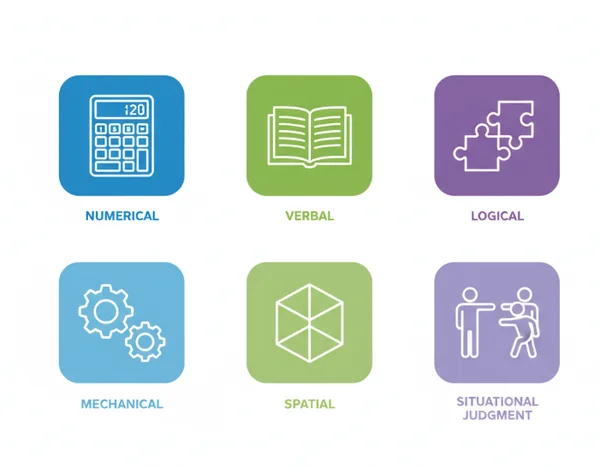
Not every aptitude test measures the same thing. Each type targets a specific cognitive skill. Understanding the main categories helps you know what to expect and which tests match your goals.
Numerical Reasoning
This type measures your ability to interpret data, work with charts, and solve problems involving numbers. You do not need advanced math — it focuses on logic applied to everyday numerical scenarios like percentages, ratios, and data tables.
Verbal Reasoning
Verbal reasoning tests evaluate how well you understand written passages, draw conclusions, and spot logical errors. Strong verbal reasoning often correlates with careers in law, communications, and management.
Logical and Abstract Reasoning
These tests present patterns, shapes, or sequences and ask you to identify the underlying rule. Because they rely on pure logic rather than language or numbers, they are considered among the most culture-fair assessments available.
Mechanical Aptitude
A mechanical aptitude test checks your understanding of physical principles — forces, levers, pulleys, and basic mechanics. This test type is common in engineering, manufacturing, and skilled-trade hiring processes.
Spatial Reasoning
Spatial reasoning gauges your ability to visualize objects from different angles and mentally manipulate shapes. It is especially relevant for architecture, engineering, and certain scientific fields.
Situational Judgment
Rather than testing abstract thinking, situational judgment tests present realistic workplace scenarios and ask how you would respond. They reveal your decision-making style and interpersonal instincts.
How a Career Aptitude Test Helps You Choose the Right Path
A career aptitude test goes beyond raw cognitive measurement. It connects your natural abilities, interests, and personality traits to specific career families. Instead of guessing which jobs might suit you, the test provides data-driven direction.
Matching Strengths to Career Families
Career aptitude tests typically combine several aptitude dimensions into a profile. That profile is then matched against a database of occupations. For example, someone with strong verbal reasoning and high empathy scores might see recommendations in counseling, education, or human resources.
When to Take a Career Aptitude Test
There is no single "right" moment, but these situations are especially good times:
- You are choosing a college major and want objective guidance.
- You feel stuck in your current job and wonder if a different field fits better.
- You are re-entering the workforce after a break.
- You want to confirm whether a career change you are considering aligns with your strengths.
Free vs. Paid Aptitude Tests — What Is the Difference?
Free career aptitude tests usually offer a summary of your top strengths and suggested career categories. Paid versions add depth — detailed scoring breakdowns, personalized action plans, and sometimes access to a career advisor. Both can be useful depending on how much detail you need.
Key Differences Between Popular Aptitude Tests
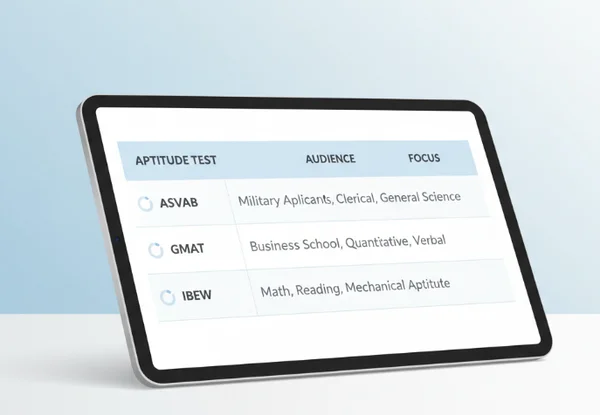
Several well-known aptitude tests serve different audiences. Knowing which one applies to your situation saves time and effort.
| Test Name | Primary Audience | Focus Area |
|---|---|---|
| ASVAB | Military applicants | Vocational aptitude across 10 areas |
| GMAT | Business school applicants | Analytical, verbal, and quantitative reasoning |
| DAT (Dental Aptitude Test) | Dental school applicants | Perceptual ability, science, and reading comprehension |
| IBEW Aptitude Test | Electrician apprentice candidates | Algebra, reading comprehension |
| Job Aptitude Tests (general) | Job seekers | Varies by employer — numerical, verbal, logical |
| Career Aptitude Tests (online) | Students and career changers | Strengths, interests, and personality alignment |
This comparison shows that aptitude tests are not one-size-fits-all. Your context determines which test matters most.
Practical Steps to Prepare for Any Aptitude Test
Preparation does not mean memorizing answers. Because aptitude tests measure reasoning, the best strategy focuses on familiarity and mental sharpness.
Step-by-Step Preparation Checklist
- Identify the test type — Know whether you will face numerical, verbal, logical, or mixed formats.
- Practice with sample questions — Timed practice builds comfort with the question style and pace.
- Review basic concepts — Refresh core skills like percentages, ratios, and reading comprehension depending on the test.
- Simulate test conditions — Practice in a quiet space with a timer to replicate the real experience.
- Focus on weak areas — After a practice round, spend extra time on the types of questions you found hardest.
- Rest and manage stress — Test-day performance improves when you are well-rested and calm.
Common Mistakes to Avoid
- Skipping practice entirely — Even naturally talented test-takers benefit from understanding the format.
- Spending too long on one question — Most aptitude tests are timed. Flagging hard questions and moving on is a smarter strategy.
- Overthinking — Aptitude questions often have a straightforward logical path. Second-guessing frequently leads to wrong answers.
- Ignoring instructions — Small format differences between test types can cause unnecessary errors.
What Your Aptitude Test Results Actually Tell You
Getting a score is only the first step. Understanding what that score means — and what it does not mean — matters more.
How Scores Are Typically Reported
Most aptitude tests report scores as percentiles. A 75th percentile score means you performed better than 75 percent of the comparison group. Some tests also use stanine scores or raw-score bands grouped into categories like "below average," "average," and "above average."
What Results Can and Cannot Predict
Aptitude test results can reliably indicate areas where you have natural talent and may suggest career directions worth exploring. However, they are not guarantees. Motivation, experience, education, and personal values all shape career success beyond what any single test captures.
Results are a starting point for self-reflection, not a final verdict on what you should or should not pursue.
How to Explore Your Career Direction With Confidence
Understanding your aptitude is a powerful first step. However, aptitude data becomes truly useful when you combine it with reflection on your interests, values, and life goals.
If you are ready to take the next step, consider using a structured career exploration tool. A well-designed career quiz can help you organize your thinking and see how your natural strengths connect to real career options — without pressure or commitment.
This kind of tool is designed for self-exploration and reflection. It does not replace professional career counseling or clinical assessment.
Key Takeaways on Aptitude Tests and Career Planning
Aptitude tests measure your natural potential, not your past achievements. They are used across education, employment, and career guidance to help match people with roles where they can thrive.
Here is what to remember:
- There are many types of aptitude tests — pick the one that fits your current goal.
- Preparation focuses on familiarity and strategy, not memorization.
- Scores indicate potential but do not define limits.
- Combining aptitude results with personal reflection gives you the clearest career direction.
Whether you are preparing for a specific test or simply exploring your strengths, taking the time to understand your aptitudes is one of the most practical investments you can make. Explore a free career aptitude test to start mapping your career possibilities today.
Frequently Asked Questions
What is the best free aptitude test for career guidance?
The best free career aptitude test depends on your goals. Look for one that combines interest, personality, and cognitive-ability dimensions rather than measuring only one factor. Online tools like CareerQuiz.me offer a science-based starting point for self-exploration.
How long does a typical aptitude test take?
Most aptitude tests take between 20 and 60 minutes. Career aptitude tests tend to fall on the shorter side, while employer screening tests or military aptitude batteries like the ASVAB may take several hours.
Can you fail an aptitude test?
Aptitude tests do not have a pass or fail in the traditional sense. They measure where your strengths lie relative to others. However, some employers or programs set minimum score thresholds for specific roles or admissions.
Do aptitude test results change over time?
Core cognitive aptitudes tend to remain stable through adulthood. However, practice, education, and experience can improve your performance on specific test types, and interests may shift as your career evolves.
What is the difference between an aptitude test and an IQ test?
An IQ test measures general intelligence as a single score. An aptitude test breaks ability into multiple dimensions — verbal, numerical, spatial, mechanical — giving a more detailed profile of where your specific strengths and weaknesses lie.
How accurate are online career aptitude tests?
Accuracy depends on the scientific rigor behind the test. Assessments based on validated psychological frameworks provide more reliable results than informal quizzes. Use results as directional guidance rather than absolute answers.